
Part 4 of the Modern Cat Ownership Series
If you are wondering how to introduce two cats without causing a total household war, you’ve probably heard the “old school” advice that makes every professional behaviorist cringe: “Just throw them in a room together; they’ll figure it out.” Or perhaps the slightly more “modern” but equally disastrous: “Put one in a carrier and let the other one sniff them out.”
To that, I have a very simple, very firm response: NO, but HELL NO.
In my years as a professional cat specialist and a Fear Free® certified provider, I have seen the fallout of these “shortcuts.” I have witnessed the long-term trauma, the broken bonds, and the fractured households that result when people don’t understand the right way how to introduce two cats to one another. It has traumatized me just as much as it has the cats.
If you are reading this, you are a “Pet Parent” who views your cats as cherished family members. You want a peaceful “kingdom,” not a battlefield. This brings us to the final part of our series on Modern Cat Ownership. Today, we’re moving past the “Rule of Three” and into the delicate art of the Slow Introduction.
Why Don’t My Cats Get Along Instantly?
Before we talk about gates and treats, we have to understand the why. We often assume that because cats live under the same roof, they should be “friends.” But in feline behavior, “friendship” isn’t a binary yes or no. It’s a complex map of alliances, neutral zones, and genetic predispositions.
To understand how your resident cat feels, I’ll share a secret from my own childhood: I am the oldest of my siblings. I clearly remember the day my mom brought my sister home from the hospital. I looked at that new being and told my mom to take her back. I didn’t want her! She was my mom, and I wasn’t going to share.
I became naughty; I had “evil” thoughts toward this new intruder. Why? Because my world—my resources, my attention, and my security—was being threatened.
Imagine your cats feeling the exact same way. When you bring a new cat into a home with existing cats, you aren’t just adding a family member; you are introducing a “threat” to the resident cat’s kingdom. They don’t understand that there is enough love to go around. They only know that their “Mom” and their “Territory” have been breached. If we don’t acknowledge those “naughty” feelings, we set them up for a lifetime of sibling rivalry.
What is the First Step in Introducing a New Cat?
You cannot start a social introduction until your new cat is “at home” in their own space. If you missed Part Two of this series, go back and read about the Rule of Three.
Your new kitty must be feeling comfortable and confident in their “sanctuary room” before you even think about showing them to the resident cat. If the new cat is still hiding under the bed, they aren’t ready to defend their “social resume” to a stranger. We need them eating, playing, and acting like their true selves first.
How Do I Use a Baby Gate for Cat Introductions?
Once everyone is confident in their separate spaces, it’s time to create a visual bridge. Cats do not understand that there is an invisible barrier between them; they only see an intruder.
Most cats can clear a standard baby gate in a single leap, which defeats the purpose. I recommend stacking three baby gates in the doorway. They need something they can see through, but not get over or around. This creates a floor-to-ceiling barrier that allows for total visibility and scent exchange, but zero physical contact.
Why is this better than a carrier? A cat in a carrier is a “trapped” cat with no flight response. A cat behind a gate feels they can walk away if things get too intense. That sense of “choice” is the cornerstone of Fear Free® care. It removes the need for those “evil” defensive thoughts because the gate provides a physical guarantee of safety.
How Can I Create a Positive Association Between Cats?
Now, we begin the work of Positive Association. We are essentially “bribing” the older sibling to like the new one using high-value rewards.
- The 3-Foot Rule: Start with a high-value treat (like a Churu, catnip, or wet food) and put it about three feet from the gates on each side.
- The Goal: Have one cat on each side enjoying their treat simultaneously. There will be some hissing, but at that distance, they still feel they can escape.
- The Slow Crawl: As confidence improves, move the treats closer. The closest I would get is about six inches from the gate. When the new cat appears and the Churu comes out, the resident cat starts to think, “Maybe this new being isn’t so bad if her presence means I get my favorite snack.”
When Should My Cats Meet Face-to-Face?
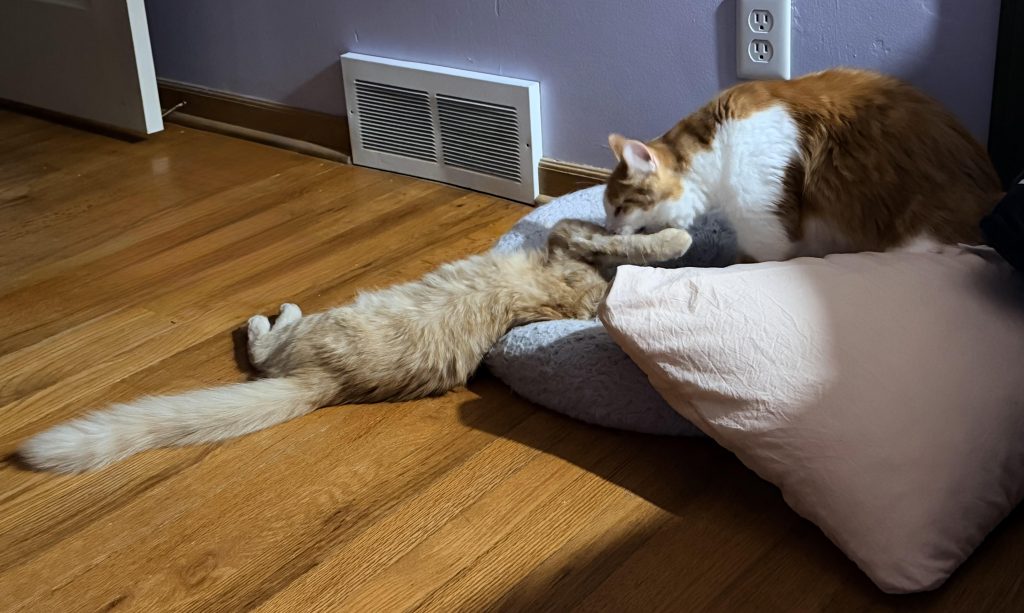
Once the cats are consistently calm at the gates, you can move to a face-to-face meeting. This must be done in an enclosed room that is open and has no hiding places. You do not want a cat to get under the bed, start a fight, and leave you unable to help.
All of this engagement is done in small, supervised periods several times a day. While they are face-to-face, keep them engaged with a toy or feed a wet treat side-by-side. You are there to be the “referee” and the source of all things fun.
How Do I Transition Cats from Supervised to Alone Time?
Even when the face-to-face sessions are going well, this is a graduation process. Do not rush to leave them alone immediately.
- The Daylight Phase: Once they are peaceful during supervised sessions, let them be out together during the day while you are home and within reach.
- Nighttime Separation: Even if the day went perfectly, I would still separate them at night. Nighttime is when feline energy peaks, and you can’t intervene if a “sibling rivalry” flares up while you’re asleep.
- The “Short Trip” Test: Start taking short trips out of the house—go to the store or take the dog for a walk. Leave them alone for 30–60 minutes and see how they fare.
- The Final Graduation: Eventually, they will graduate to being home together all day while you are at work, peacefully watching “Bird TV” out the windows.
Why is One-on-One Time Important in Multi-Cat Homes?
As you navigate this, remember: they still need their one-on-one time with you. Just like I didn’t want to share my mom, your resident cat needs to know they haven’t been replaced.
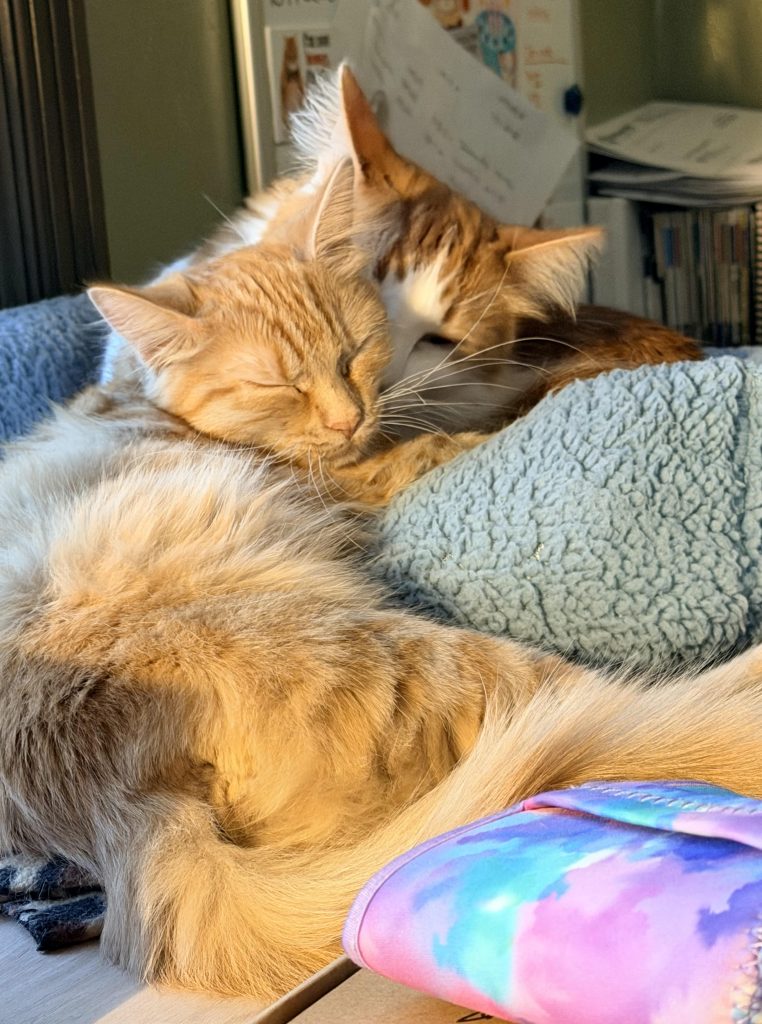
And here is the biggest difference between human siblings and our feline ones: Our cats do not leave the nest. They don’t grow up, go to college, and move on. You, your resident cat, and your new addition are in this together for the long haul. You are building a family that will live under one roof for quite some time, so taking the extra weeks (or months) to do this right is an investment in your home’s peace.
How Long Does a Cat Introduction Take?
I cannot tell you how long this will take. I didn’t learn to love my sister in a single afternoon; it took years of shared experiences.
It does not go at your pace; you are on their time. If you rush this process, you validate the resident cat’s fear that the “new sibling” is a threat. Modern cat ownership is about being a guardian of their mental health. By taking the time to do a slow, respectful introduction, you are building the foundation for a lifetime of peaceful coexistence.
If you’re feeling overwhelmed, remember: you don’t have to do it alone. Whether you need a professional eye to evaluate your “gate sessions” or you need a Fear Free® specialist to maintain the routine while you’re traveling, the “Aunties” at Just Fur-Babies are here for you. We care for your fur-babies where they love to live—and we make sure they love living together, too.