
In my previous posts, we explored [Modern Cat Ownership: Why It’s Different Today ] and how to successfully [How Long Does It Take for a Cat to Adjust to a New Home?]. But if you are looking to expand your clowder—or if you’re wondering why your current cats keep fighting—there is a missing piece of the puzzle: Feline Social Circles.
We often assume that because cats live under the same roof, they should be “friends.” But in feline behavior, “friendship” isn’t binary. It’s a complex map of alliances, neutral zones, and genetic predispositions.
Are Cats Loner Animals or Social Creatures?
Cats are facultatively social. This is a fancy way of saying they can live alone if resources are scarce, but when food and safety are plentiful (like in your home), they often choose to form social groups.
However, unlike humans who belong to one “family” unit, cats organize themselves into Affiliative Groups. Even in a house with only two cats, you might not have one cohesive group; you might have two separate social circles living under one roof.
What are the 3 Types of Cat Social Circles?
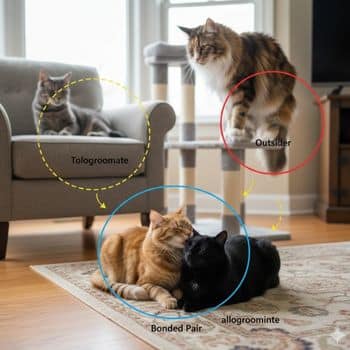
When you have two cats, their relationship usually falls into one of three “maps.” Understanding which one your cats belong to is the first step toward a peaceful home.
The Bonded Pair (1 Shared Circle): These are the “soulmates.” They engage in allorubbing (rubbing bodies together) and allogrooming (licking each other). This creates a “group scent” that says, “You are part of me.”
The Tolerated Roommates (Overlapping Circles): These cats sit on opposite ends of the sofa. They might eat near each other without tension, but they don’t cuddle. They are “work colleagues”—civil, but they prefer their own space.
The Outsiders (2 Separate Circles): To these cats, the other is a “stranger” occupying their territory. This is where you see the “hiss-and-run,” the blocked hallway, or the intense “stare-downs.”
The Behavior Goal: We don’t necessarily need every cat to be a “Bonded Pair,” but for a peaceful home, we want them to at least reach “Tolerated Roommate” status.
Can Littermates Have Different Personalities?
You’ve heard it before: “They’re littermates, so they’ll always be best friends!” However, biology often throws a curveball through a process called superfecundation.
A single litter of kittens can actually have multiple fathers. Because a queen releases eggs over several days, she can mate with different toms. This results in half-siblings with very different “genetic blueprints” sharing the same womb.
How Do Father’s Genes Affect Cat Behavior?
Decades of research (such as landmark studies by S. McCune and Turner et al.) show that a kitten’s boldness and friendliness are heavily influenced by their father’s genetics.
- If Cat A’s father was a bold, social tom, they might be a “social butterfly.”
- If Cat B’s father (from the same litter!) was a wary or fearful tom, that cat may naturally struggle with social integration.
When littermates “stop getting along” as adults, it is often because their diverging genetic temperaments are finally manifesting.
How Do I Map My Cats’ Social Circles?
I want to challenge you to be a “Cat Observer” this week. Watch how your cats interact without interfering. You are looking for Affiliative Behaviors (friendly) vs. Avoidance (hostile).
| Behavior | What it Means for the Social Map |
| Allogrooming | Strongest bond; definitely the same social circle. |
| Intertwined Tails | High levels of trust; they consider each other “family.” |
| Parallel Play | Playing near each other; “Roommate” status. |
| The Stare-Down | Blocking access to rooms; separate social circles. |
Why is Respecting the Social Map the Only Path to Harmony?
Through our behavior consulting, we find that once owners “map” these circles, their frustration turns into relief. Understanding your cats’ social circles isn’t just a fun project—it is the foundation of a low-stress home.
When we force cats to interact, share resources, or “cuddle” against their will, we aren’t encouraging friendship. We are creating chronic stress.
The Danger of Forcing Feline Relationships
It is vital to remember that social bonds are the cats’ decision, not ours. If you try to force a relationship between cats in separate circles, you can cause psychological trauma that is incredibly difficult to redo.
- Broken Trust: Forcing a “face-to-face” interaction can lead to a fight that permanently scars their relationship.
- Invisible Stress: A cat who feels their “circle” is being invaded may stop eating, develop litter box issues, or live in a constant state of hyper-vigilance.
By mapping their circles and providing multiple resources—like separate feeding stations and vertical climbing paths—you give them the autonomy they crave. Harmony means every cat feels safe and respected, even if they aren’t “best friends.”
What’s Next?
Now that you’ve mapped your cats’ social circles and understand that their “dad’s genes” might be playing a role in their personality, you’re ready for the final step.
In our next and final installment, we will take all this knowledge and apply it to Integrating into a Multi-Cat Household. We’ll discuss how to introduce a “wildcard” into established circles without causing a feline revolution or causing irreparable trauma.